
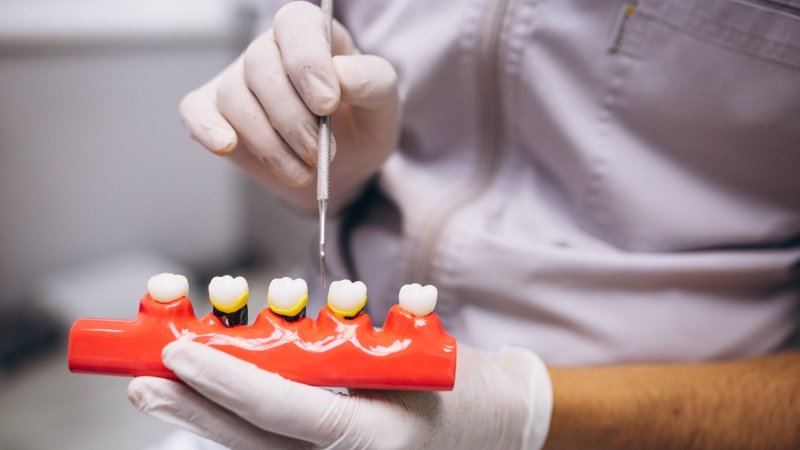
Losing a tooth is not that rare, nor is it as common as well. Nobody intends to lose their teeth. But it happens due to factors like age, decay, gum disease, or mishaps like road accidents or other such traumatic issues. The crux of a missing tooth is that it takes a toll on aesthetics, confidence, nutrition, and speech. Elderly people are the ones who often ignore those missing teeth and finally realise the nutritional loss after the damage is done. Thus, it is not optional but mandatory to replace the missing teeth to regain the oral functions.
When a tooth is missing, dentists often suggest many solutions, such as implants, fixed dentures, removable partial dentures, and, most commonly, a dental bridge. The most common reason to suggest dental bridges is that they are not expensive like dental implants, are non-invasive, and are comfortable for the patients and work perfectly. This blog explains what a dental bridge is, the types available, and how much it usually costs, in very simple terms.
What is a Dental Bridge?
A dental bridge is a dental prosthesis that replaces one or more missing teeth by taking support from the adjacent healthy teeth or an implant. It stays in your mouth permanently and is permanently fixed using a cement, which means only a dentist can take it out if needed. You can’t remove it on your own.
Why Do Dentists Suggest Dental Bridges?
A missing tooth can cause problems over time. Dental replacements, like a dental bridge, are necessary. Ignoring replacement or treatment leads to future problems like:
- Chewing becomes uneven
- Nearby teeth start moving and take up the space of missing teeth
- Food gets stuck easily
- Speech may change or become slurred
A dental bridge fills the gap created by the missing teeth and helps restore normal function.
Types of Dental Bridges
There is no single bridge that suits everyone. Dentists choose the type based on where the tooth is missing and the health of the nearby teeth, and also as per the patient’s needs and requirements. Let’s learn more about the various types of dental bridges.
Traditional Dental Bridge
This is the most common type. In this type of bridge, the healthy teeth on either side of the missing tooth are used as support. These healthy teeth are shaped and trimmed, and crowns are placed on them to hold the artificial tooth in between. The artificial tooth is called a pontic, and the support teeth are called abutments.
Usually suggested when:
The teeth next to the missing tooth are strong and healthy.
Cantilever Dental Bridge
This bridge is supported by only one nearby tooth.
It is not used everywhere in the mouth.
Usually suggested when:
The missing tooth is in the front, and the biting pressure is low.
Maryland Dental Bridge
This bridge does not need full crowns over abutment teeth.
Instead, thin wings are bonded to the back of the nearby teeth.
Usually suggested when:
This is suggested when only one front tooth is missing, the patient is young, and the dentist wants to avoid trimming healthy teeth.
Implant-Supported Bridge
Here, the bridge is supported by dental implants instead of natural teeth.
This option is stronger but takes more time.
Usually suggested when:
Multiple teeth are missing, or nearby teeth are not suitable for support.
Types of Dental Bridges at a Glance
| Type | Support Tooth | Cutting | Indication |
| Traditional | Two natural teeth | Yes | Front and back teeth
|
| Cantilever | One natural tooth | Yes | Front teeth
|
| Maryland | Bonded wings over the back side of two adjacent teeth | Very little | Front teeth
|
| Implant supported | Dental implants | No | Multiple missing teeth
|
Materials Used in Dental Bridges
The bridge can be made using different materials.
The choice depends on appearance, strength, and budget.
Common materials include:
- Metal-fused-to-ceramic
- Full ceramic
- Zirconia
- Metal alloys
Front teeth usually need tooth coloured materials.
Back teeth need more strength.
Dental Bridge Cost in India
Costs depend on material, location, and the dentist’s experience.
Here is a simple idea of the usual range per tooth.
| Type | Approximate Cost (INR)
|
| Metal-ceramic bridge | ₹4,000 to ₹8,000
|
| Full ceramic bridge | ₹8,000 to ₹15,000
|
| Zirconia bridge | ₹15,000 to ₹25,000
|
| Implant-supported bridge | ₹25,000 to ₹45,000
|
These are general estimates. The final cost depends on factors like city, dentist expertise, type of fabrication process, and number of teeth being replaced.
How Long Does a Dental Bridge Last?
A dental bridge does not last forever.
With good care, it can last 8 to 15 years.
Some last longer.
Some may need replacement earlier if the hygiene is poor.
Advantages of Dental Bridges
- Fixed solution
- Feels natural while eating
- Improves appearance
- Faster than implant treatment
- Cost-effective for many patients
Things to Keep in Mind
- Supporting teeth must be healthy
- Cleaning under the bridge is important
- Regular dental visits are needed
- It does not stop bone loss in the missing tooth area
Dental Bridge vs Dental Implant (Simple Comparison)
| Factor | Dental Bridge | Dental Implant
|
| Treatment time | Short | Longer
|
| Surgery | No | Yes
|
| Tooth trimming | Yes | No
|
| Cost | Lower | Higher
|
Dental Bridge: Care Tips and Maintenance
Routine dental care works for them like:
- Brushing twice a day with medium bristles toothbrush, do not use very hard bristles or abrasive toothpaste.
- Cleaning under the bridge using floss or interdental brushes does magic in saving your bridge and gums from infections and dislodgement.
- Avoid biting very hard objects with the bridge teeth
- Visit your dentist regularly for professional cleaning and a routine checkup
In a Nutshell
Dental bridges are something that has been used in dentistry for a long time; they have evolved with the new generation practices and materials to keep up with the modernisation. Dental bridges are loved by patients because they are affordable, non-invasive, functional, and acceptable. The dentists choose dental bridges because they are predictable, practical, and work well when placed correctly. Visit World Life Magazine for more information.
Dental bridges are mostly suitable for the maximum number of patients. Still, your dentist is the perfect person to eva